The Harvington History Trail
We hope that you are enjoying the Harvington History Trail. This page includes more information on the houses for you to enjoy.
Here also is a link the Harvington History website created by Julian Rawes, where there is loads of detailed information about the village's long history.
Harvington Baptist Church
In 1886 a 'Mission Room' was opened in Harvington. Initially it was non-denominational but in time
linked with Atch Lench Baptist Church which was thriving and had planted Churches at Dunnington
and Temple Grafton. The piece of land that it stands on was bought for £5. Once the church was
complete two sycamore trees were planted outside, one of which is still there today.
The Ministers at Dunnington and later Evesham Baptist Churches had oversight of the Church until
1986 when the Harvington Church became an independent Baptist Church linked to the
Baptist Union.
The principal family who helped to set up the church in 1886 were farmers, but can you
find their name?
Bridge 63
After nearly 100 years of service the Evesham & Redditch Railway closed in 1963. The Station
House was converted to a private residence and later owned by David Hutchings. He also bought
the 19th century bridge from British Rail hoping for planning permission to convert that to a house
too. It was completed in 1981 and is one of the most unusual buildings in the village. The current
owners have revived it after some years of standing empty.
Find out more about the Harvington Ghost Train here.
Use the small white gate to see the front of the house - during festival time only.
Can you find the exact date of when the station opened for passengers?
The Coach and Horses
The building fronts onto Church Street with its range of outbuildings set behind; the present building appears relatively modern but there is evidence of a much older structure within the current building.
The first Innkeeper so far found is Joyce Tobey in 1718 but perhaps the most notorious one was
William Bromley, landlord from 1905. He was also the village undertaker and he carried on his
business from the present day function room. The table in the public bar was used to lay out corpses.
was last used for that purpose when a Mr Bromley died in 1934 whose fixtures and fittings were
sold to the Brewery for £53.13s and 6d.
What is the next event to take place at the Coach and Horses?
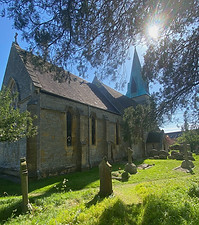
St James the Great
This beautiful Grade I listed building includes a nave and chancel generally accepted as early fourteenth
century, but an older tower, possibly late 11th century. Later in the 14th century the church was rebuilt
and enlarged: the width of the nave was increased and windows were inserted in the nave and chancel.
The church contains examples of stained glass by the Victorian architect Frederick Preedy, and is
included in the Evesham Preedy trail. The church is known in the surrounding area for its unusual, and
very distinctive, green spire.
Where would you find the NEWS at this church?
Crooked Walls
Dating from the 1400s, Crooked Walls is thought to be one of the oldest houses in the village,
with a detailed history available on the Harvington History website.
The current owners found two hand written receipts from 1671 and 1681 for fire hearth tax under
floorboards. Then the house belonged to a John Clarke who was a Yeomen and churchwarden.
A second note records the death of an Annie Clarke (1667) a relative of some kind.
By the 1920s the house was divided into 4 cottages, one of which contained 13 children. It
became derelict in the 1930s and was used as a carpenter’s shop and a stable for horses before
being restored to a family home once more.
How many chimneys can you see on the roof?
Thatcholm
This 16th century listed cottage hosted evacuees from Birmingham in World War II. Evacuees arrived
by train and slept in the Village Hall overnight before being chosen by host families the next day.
Ironically one of the cottage’s previous inhabitants, George Withers was killed in 1915 in Northern
France in World War I when he was just 21. He is buried with his father in the graveyard in
Harvington. Can you find the name of George’s father?
Thatchways
Dating from about 1500, Thatchways is fondly nicknamed the ‘chocolate box cottage’ not only for
its classic black-and-white appearance but also because it appeared on a Cadbury’s box of
chocolates in the 1970s when the company first produced a series of chocolates showcasing
traditional English scenes which launched the term ‘chocolate box’.
Jacob the ‘ghost cat’ has been a long term loyal resident and spectre. He has appeared to many
residents over the years, (including the current owners). It seems apt that the unusual thatch with its
very rare roof is called ‘cat slide’.
Perhaps Jacob himself is as old as the 17th century …. Who knows?
Where might you find Jacob now, clutching at straws?
More about Thatchways
Thatchways began life as a simple one up one down cottage now forming the entrance hall and dining room.
Over the years, it has evolved through several stages of extension and alteration, including the addition of a front wing with a bread oven, typical of the period.
Today, the cottage is a charming one and a half storey home with an intriguingly non-traditional layout featuring three/ four bedrooms with three ensuite bathrooms and two staircases- a reflection of its gradual organic development.
But Thatchways is known for more than its architecture. It has become part of the villages collective memory, with locals and visitors sharing fond stories stretch back generations. Even after 23 years, the current owner is still welcoming people who recall the cottage and its legends.
Thatchways is one of the oldest houses in the village with a visible bread oven on the front and a cruck frame to be seen in the end wall. This is a split oak tree which runs from the ground to the roof apex.
The Old Rectory
The Old Rectory started life as an Elizabethan cottage possibly used by curates who would not
have been able to afford to live in a larger house. This all changed when Canon
Winnington-Ingram (Rector 1845-1887) arrived and transformed the property into the Rectory.
He felt that the existing property was ‘far too small’. He was wealthy and scholarly, substantially
enlarging and improving the building.
The enlargement of The Rectory was one of several projects Cannon Winnington-Ingram
undertook as he was also involved in starting the Village School and he also donated a
large sum to the Worcester Infirmary.
There are rumours of two ghosts, but none have been seen lately.
Read more on the Harvington History website - www.harvington-history.org.uk
Can you guess which village event was held in the gardens until the 1980s?
More about The Old Rectory
Cannon Winnington-Ingram built a new East wing, the left side of the house as you look from the current drive which included some substantial reception rooms. You will notice that the brick on this side of the house looks substantially newer than the right side of the house.
The left hand large window on the ground floor is an example of a 3 part venetian window. This room originally was a Church Reading Room for bible studies. It is now divided into a second lounge and cloakroom.
There were two staircases leading to 8 bedrooms. The second staircase no longer exists and sat where the new single story extension to the right of the Rectory as you look at it.
He also added stables to hold 4 horses, a coach house and accommodation for staff along with outbuildings which were to the right of the current building and stretching into the neighbouring property.
List of Occupants since 1845:
A H Winnington-Ingram 1845 -1887
Theophilus Sharp 1887-1895
J H Waugh 1895 -1908
James Davenport 1908 -1930
H T Boultbee 1930 -1949
E H Downey 1949 -1957
C P Johnson 1957-1969
Bernard Palmer 1969 -1978
Cedric Eve 1978 -1984
Lorentz and Maxine Gullachsen 1984 -1986
John and Sue Jenkinson 1986 -2013
Jon Fairchild and Debbie Pennington 2013-
Modern Timeline
Back in the 1960’s we have a letter from the current Rectory to the Church Commissioners saying that the Rectory is too drafty and too expensive to run and can they move him to newer accommodation.
The church had the property surveyed and the surveyor stated that the property would be unlikely to reach a sale price of more than £6,250!
In 1965 a substantial part of the older building was knocked down as it was unsafe, the remaining house was modernised.
During the 60’s and 70’s various plots of land were sold off and houses were built.
In 1984 the Rectory was sold by the Church Commissioners to private owners being Lorentz and Maxine Gullachsen and its name changed to The Old Rectory. A new Rectory was built on Station Road to house future Rectors.
The Old Rectory Facts
Harvington village Fete was held in the garden until the 1980’s – older villagers may remember it – see photos
There is a deed where we can’t pretend to be the Rector and we can’t sell alcohol:
Not ‘a place of amusement, hotel, tavern, inn or public house not shall any spiritous or fermented liquors at any time be sold in or upon the property’.
We have heard rumours that there is a female ghost that haunts the side garden after her husband killed her for nagging too much! We have never seen or heard any signs of a ghost there.
There is a rumour a 5 year old child fell down the servant stairs holding a pair of scissors and killed herself.
Langton House
The date of the house is something of a mystery as it house a mixture of features pointing
to different eras and a possible earlier building. However the first named occupier,
Reverend Joseph Stevenson, the curate, who arrived in 1867. He would be the first of many
owners who moved into Langton House from outside the county.
A Frederick Pick from Leicestershire was the next resident who used the house and land
as a farm from 1887. A short two years later a local boy, George Penney bought the
house and went on to make his fortune in Drapery in London, before retiring back to Harvington.
The house is then owned by a fruit pulp manufacturer and is used as a Retirement Home during World War II, before housing the grand-daughter of Gustav Eiffel of tower fame.
We think Langton House was built around 1740 which means that it is older than which modern day super power?
The Golden Cross
There was a tradition in Medieval times of planting large trees such as elm or oak on junctions
to act as way markers. The Harvington ‘cross’ has an elm tree named in 1876 records. The pub
however did not begin life until about about 1840, starting as a cider house in a pair of old
converted cottages.
In 1911 Samuel Coley was the Innkeeper. During World War I he profited from the Defence of
the Realm Act (Dora) which banned the sale of alcohol within 25 miles of a factory owing
to ‘drunkenness’. There was a munitions factory at Redditch and happily Golden Cross was just
outside the limit, profiting from visitors from the north.
Can you find the names of the landlord/lady today?
_________________________________________________________________________________
A Harvington Victorian Poem
In 1868 there was a curious old custom still observed at Harvington; the children used to go round to all the houses on St Thomas's Day and St Valentine's Day repeating a doggerel rhyme as follows:-
'Wissal, wassail, through the town,
If you've got any apples throw them down,
Up with the stocking and down with the shoe,
If you've got no apples money will do.'
Recorded by Mrs Edith Towers when a child sang it at her door at Firbank in 1910.